Why the cheapest water park equipment often ends up costing you the most
Nov 01, 2026
Now, the global water park market is on a steady growth trajectory, with projections indicating an expansion from approximately $16 billion in 2025 to over $27 billion by 2034—a compound annual growth rate (CAGR) of about 6%. The specific segment comprising water rides and slides alone is expected to reach a valuation of $32 billion by 2035. Driven by a 63% increase in household leisure spending and a 52% rise in tourism-related entertainment expenditure, water parks have firmly established themselves as one of the most attractive segments within the global leisure economy.
Yet, beneath this industry growth, a recurring pattern persists: investors who aggressively push for the lowest possible prices during equipment procurement often end up with the poorest long-term returns. This is because a critical factor—The Total Cost of Ownership(TCO)—often overlooked during the procurement.
For water slides and various types of water attractions, the initial purchase price represents only a fraction of the total cost. Over a typical 10- to 20-year operational lifespan, the cumulative costs—encompassing maintenance, operational downtime, refurbishments, safety-related liabilities, and lost revenue from visitors due to facility closures—can amount to three to five times the initial capital investment.
Part Ⅰ: The True Cost Structure of Water Park Attractions
When evaluating equipment, most first-time investors tend to focus on a single dimension: the unit price. However, the financial performance of water park attractions over their entire lifecycle follows a very different logic. Below, we break down the true cost components behind the investment.
Initial Procurement Cost
This is the most straightforward figure—the quoted price for water slides, play towers, wave-making systems, or integrated attraction complexes. It encompasses manufacturing, transportation, and basic installation. For a typical mid-sized water park, equipment procurement accounts for approximately 40%–55% of total capital expenditure. While significant, this is far from the whole costs.
Maintenance And Upkeep
This is the area where hidden costs most easily accumulate. Industry benchmarks indicate that annual maintenance expenditures rise in proportion to the scale of the park and the volume of visitors.
Over a 10-year operational cycle, a high-traffic park may spend an amount equivalent to 50%–80% of the original equipment value on maintenance alone. This is where the difference between product quality and price becomes apparent: a well-crafted fiberglass slide with a high quality gel coat finish typically requires only routine cleaning and waxing, whereas an inferior product may necessitate frequent gel coat repairs, leak-proofing, and structural reinforcement.
Downtime And Revenue Loss
When an attraction is taken out of service for maintenance or repairs, it not only leads to a direct loss of revenue from admissions, food and beverage sales, and other ancillary services, but it also erodes visitor trust and damages brand reputation. The peak season for a water park typically lasts only 60–90 days per year, during this period, even a one-week closure of a core attraction can have a severe impact on the season’s overall profitability. Therefore, equipment reliability is by no means a mere "nice-to-have" feature, it is a core driver of revenue. Equipment with a 98% uptime rate can generate significantly higher profits compared to equipment with only an 85% uptime rate—making it a worthwhile investment, even if the initial purchase price is 15%–20% higher.
Refurbishment In Mid-term Overhauls
While the structural substrates of fiberglass-reinforced plastic (FRP) surfaces can typically last for 25 to 50 years or more, the gel coat—the outer protective layer—has a shorter lifespan. After approximately 15 to 20 years, it often exhibits noticeable fading, chalking, or surface wear. For commercial water parks with high operational loads, this timeframe may be even shorter.
Mid-term refurbishment—which may include re-applying gel coat, repainting, replacing worn moving parts, or restoring themed elements—can cost between 20% and 40% of the original equipment price. Therefore, opting for equipment manufactured using advanced surface technologies can extend the interval between refurbishments and reduce the scope of work required.
Safety Liability And Compliance
Equipment that fails to meet compliance standards not only poses a risk of accidents but also threatens the viability of the entire project. A safety incident can lead to catastrophic consequences, including mandatory shutdowns by regulatory authorities, legal liability claims, increased insurance premiums, and damage to the brand’s reputation.
Part Ⅱ: The Economics of Equipment Lifespan
Let’s illustrate this point with a hypothetical comparison. Imagine two water park investors—let’s call them “Park A” and “Park B”—who are each developing a medium-sized family water park. Both parks feature an identical lineup of water slides, play structures, and wave pools.
Cost Dimension
Park A (Budget Option)
Park B (Quality Option)
Initial equipment procurement
$1,000,000
$1,200,000
Annual maintenance (year 1–5)
$60,000/yr (6% of value)
$36,000/yr (3% of value)
Annual maintenance (year 6–10)
$80,000/yr (8% of value)
$48,000/yr (4% of value)
Mid-life refurbishment (year 8)
$300,000
$120,000
Average seasonal downtime
18 days
5 days
Estimated lost revenue per downtime day
$8,000
$8,000
10-year TCO (excluding downtime)
$2,000,000
$1,800,000
10-year downtime cost
$144,000
$40,000
Total 10-Year Cost
$2,144,000
$1,840,000
* The data above is provided for reference only and is based on industry benchmarks. Actual costs may vary depending on project scope, geographic location, and operational conditions.
The conclusion is compelling: over a 10-year period, opting for a lower-priced "economy" solution actually results in an additional $304,000 in total costs. This calculation does not even account for intangible business risks, such as visitor dissatisfaction stemming from the dated appearance of attractions or frequent unscheduled downtime, negative online reviews, and long-term erosion of brand value.
What has led to this cost gap?
This cost difference stems from three core manufacturing standards and low-cost suppliers often compromise on:
FRP Resin Quality & Laminate Layup
Low cost manufacturing often employ thinner laminate structures, lower-grade resins, and accelerated curing processes. While these shortcuts may reduce initial raw material and labor costs, they come at the expense of the product's impact resistance, UV stability, and long-term structural fatigue performance.
Anti-corrosion For Steel Structures
The environment of a water park poses a significant challenge for corrosion protection, characterized by chlorinated water, sustained high humidity, and frequent splashing. Comprehensive hot-dip galvanizing of all steel structures is essential to ensure a reliable 10-year service life. Cutting corners in this process will lead to persistent corrosion, compromising the structural integrity of the platforms and ultimately resulting in the premature failure of the equipment and incurring high replacement costs.
Surface Treatment Technology
The gel-coat surface is the part with which every visitor has the most direct contact. Surfaces produced via traditional open-mold fiberglass processes often suffer from issues such as fading, chalking, and surface roughness after several cycles of use. In contrast, advanced manufacturing processes like L-RTM can produce components with a consistent and high-quality finish on both sides, ensuring a more durable and aesthetically pleasing appearance. Furthermore, this approach simplifies cleaning and reduces the labor required for routine maintenance.
Part Ⅲ: Attractions That Truly Drive Visitation
Not all attractions contribute equally to the bottom line. Relying solely on price as a selection criterion often leads to underinvestment in the attractions that drive repeat visits.
The Shift Toward Family Entertainment
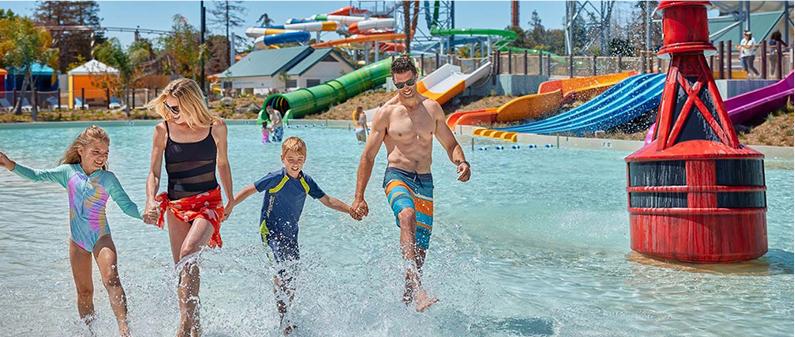
The market is clearly shifting toward experiences that are family-friendly and suitable for all ages. Data indicates that child-centric attractions account for 42% of the global demand for water park offerings, while family raft rides and shallow water play areas now make up 37% of all newly installed attractions.
This shift is critical when selecting equipment, for the following reasons:
Extreme thrill slides draw teenagers, but they target a narrower audience and tend to have faster guest turnover. While these rides remain vital for marketing hype and social attention, they are less effective at bringing families back time and again.
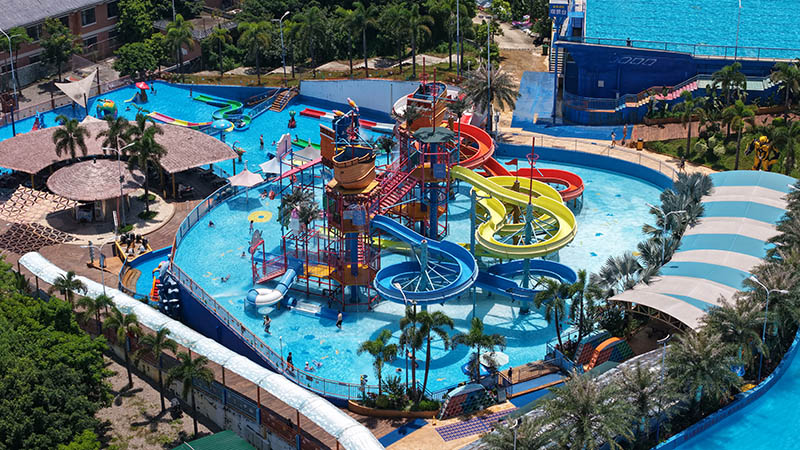
By contrast, themed play structures and interactive water encourage families to stay for hours, extending their time in the park, boosting food and beverage spending, and increasing the likelihood of return visits. The well-designed play structures can accommodate hundreds of guests simultaneously, helping to distribute crowds during peak hours and preventing excessive queuing at a few major, high-thrill slides.
Wave pools and lazy rivers serve as the "social hubs" of a water park. Offering moderate intensity and high capacity, they cater to guests of all ages and form a stable foundation for daily revenue.
Themed Vs. Generic
From a purely mechanical standpoint, a generic water slide is identical to a themed one. However, the guest experience and the potential for social media exposure are vastly different. By incorporating thematic elements, such as pirates, jungles, oceans, or fantasy worlds, an attraction transcends its role as mere infrastructure and becomes a "destination" in its own right. Investments in professional thematic design, 3D visualization, and custom-themed components are ultimately recouped through higher revenue per visitor, rather than through lower construction costs.
From a revenue perspective, themed attractions offer several key advantages:
It has higher perceived value, which justifies premium ticket pricing.
Stronger word-of-mouth and organic social media sharing.
Extended visitor dwell times.
Superior performance in highly competitive markets.
Modularity And Flexibility
Modern water park equipment is increasingly moving toward modularity. This is not merely a manufacturing convenience but an operational advantage. Modular water play towers and aquatic systems empower operators to:
Implement construction in phases, scheduling equipment deployment based on market demand and budget.
Upgrade or expand specific areas without requiring a full-park closure.
Adjust the interactive intensity of water attractions dynamically based on seasonal shifts or visitor volume.
Part Ⅳ: Risk Analysis
This is the risk most frequently overlooked by investors—one that often only receives attention after a costly accident has occurred.
The Hidden Costs Of Barely Meeting Standards
If an amusement ride platform is designed solely with the goal of passing a load test, it is highly likely to develop structural fatigue cracks after several periods of peak operation. Fiberglass components with insufficient lamination thickness may undergo delamination under repeated impact. Steel structural joints with substandard weld quality will also see their integrity gradually degrade over years of thermal expansion and contraction.
The consequences of such failures extend far beyond mere repair costs, triggering a cascade of commercial risks:
Forced suspension of operations during peak revenue periods
Regulatory investigations and financial penalties
Legal claims and high litigation costs resulting from personal injuries
Permanent damage to the amusement park’s reputation
High-quality amusement equipment is designed with an intentional safety buffer—such as using more structural steel, increasing the thickness of fiberglass laminates, conducting multiple rounds of weld inspections, and performing rigorous load verification before shipment. This carefully engineered safety margin acts as a form of operational insurance. While it increases initial capital expenditure, it provides a robust safeguard that effectively mitigates the risk of potentially catastrophic losses down the line.
After-Sales Support
When issues arise, you need a manufacturer that acts responsibly—one capable of supplying the right spare parts and promptly dispatching qualified field engineers. Consequently, a supplier’s reliability remains critical long after the final payment for the equipment has been made.
A manufacturer with a dedicated after-sales team, a robust quality traceability system and extensive experience in overseas installations is more than just a vendor; they are a long-term partner capable of supporting the stable, day-to-day operation of your facility.
Conclusion
In the water park industry, the initial quote you receive is often the lowest figure you will encounter throughout the entire investment process. The true cost of an attraction reveals itself over its 15-to-20-year service life—reflected in maintenance records, seasonal operational performance, guest feedback, and the long-term return on investment (ROI), which may either grow steadily or gradually diminish.
The global water park market is currently experiencing sustained growth, driven by an ever-increasing demand for family entertainment. Today’s guests have a wider array of leisure options, and they increasingly demand higher construction quality, operational safety, and immersive experiences. In such a competitive market, successful investors do not focus solely on the lowest initial purchase price. Instead, they prioritize attractions that offer long-term, reliable performance and effectively encourage repeat visits—a goal that requires the support of a dependable supplier.
Ultimately, the most cost-effective water park equipment is not the one with the lowest price tag, but the solution that maximizes your net profit over its entire life cycle.
Are you ready to explore your water park project?
Whether you are developing a small splash area, a family resort water park, or a large scale landmark theme park, our engineering team is here to help you plan for the economic viability of your investment throughout its entire lifecycle.
Contact Longmatic for a free project consultation and receive a customized equipment solution tailored to your site conditions, budget, and target audience.
Read More